Need a Fence That Works With Your Animals and Daily Routine?
Fence the pasture, lanes, and gates around the way the Brooksville-area property is used each day.
Field and woven wire • Horse and no-climb options • Pasture and boundary use • Equipment gate planning
Serving Brooksville, Ridge Manor, Spring Lake, and nearby acreage

FARM AND AGRICULTURAL FENCING
Plan the fence around the animals and the work.
On acreage, the fence has to do more than look good from the road. It may guide animals between areas, protect feed or equipment, divide pasture, keep dogs near the house, or create a dependable boundary along uneven ground.
The right answer changes with the animal. Horses need visible fencing with safe openings and no exposed sharp edges. Goats test weak points differently. Cattle put different pressure on a fence than smaller livestock. A boundary meant to keep wildlife out may need another approach entirely.
Gate placement matters just as much as wire or posts. Think about trailers, tractors, mowers, feed deliveries, muddy approaches, pasture rotation, and how animals move when one person is handling them.
FENCING FOR WORKING PROPERTY
Farm fencing built around the animals and the work
Horse and livestock enclosures
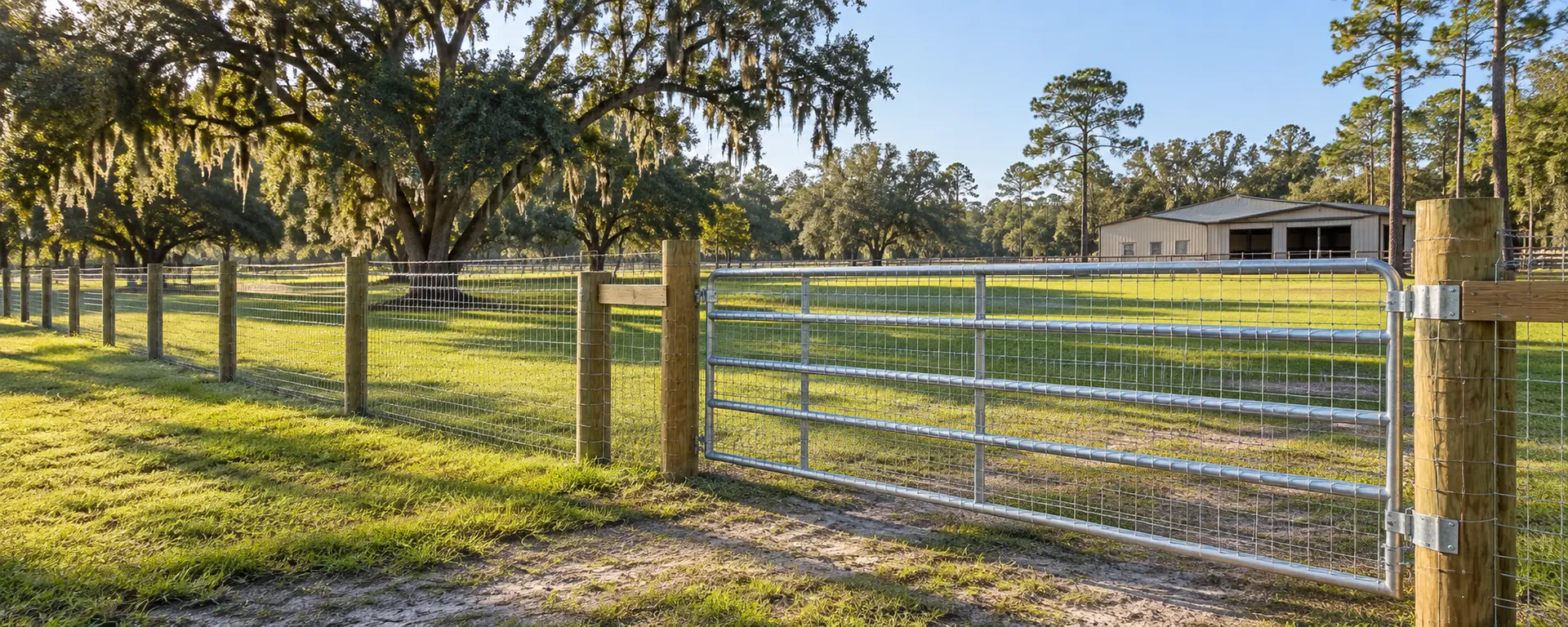
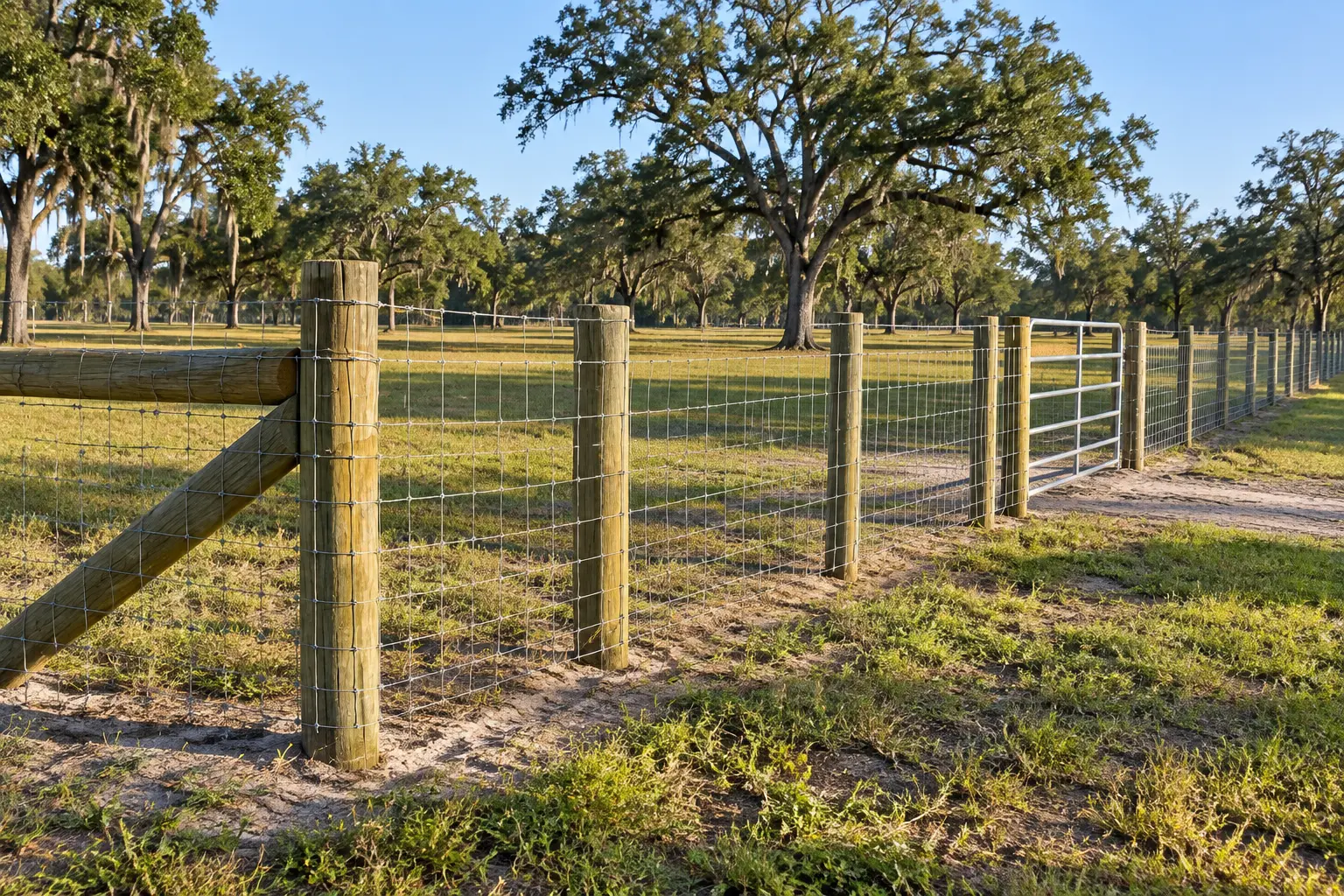
No-climb wire, woven wire, board fence, and combinations of materials can be planned around animal size, visibility, pressure, and daily handling. The layout should follow the paths the animals use between pasture, shelter, water, and gates.
Pasture divisions and longer property lines
Cross-fencing can make rotation and separation easier, while perimeter fencing defines the larger property. Terrain, low areas, existing wire, and the legal boundary become more important as the runs get longer.
Equipment and trailer access
Farm gates should be sized for the widest tractor, mower, trailer, feed delivery, or service vehicle that needs to pass. The approach and turning room are just as important as the opening itself.
Call for a Fence EstimateMatch the fence to the animal and the pressure
Woven wire and field fence cover a lot of common farm needs, but opening size, wire strength, post spacing, top treatment, and tension should match the animals. No-climb wire is often considered around horses because the smaller openings reduce entanglement risk.
Board fence is highly visible and gives a property a traditional look, but it also requires maintenance and may be paired with wire or another system depending on the containment goal. There is no single farm fence that is best for every animal.
Plan the gates before the long fence runs
A gate that works for a person or mower may be useless when a trailer, tractor, or delivery truck needs to turn through it. Measure the equipment and look at the approach, not just the opening itself.
Also think about which gates will be used every day and which are occasional access points. Daily gates need convenient placement, reliable latches, and ground that will not become a constant mud problem after rain.
Long lines make surveys and terrain more important
An error that looks small near the house becomes a much larger problem across acreage. Confirm the legal boundary instead of assuming an old fence, mowing line, or tree line is correct.
Walk the full route for low areas, drainage, washouts, roots, brush, old wire, changes in grade, and places where wildlife pushes through. Clearing and access can affect the project as much as the fence material.
PLAN THE LAND AND GATES FIRST
Farm fence planning for Brooksville, Ridge Manor, and nearby acreage
Long fence runs magnify small planning mistakes. Walking the route and talking through animals, equipment, water, shade, and daily chores usually answers more than choosing a wire sample first.
Different animals test a fence in different ways
Horses need a visible boundary with careful openings. Goats look for weak spots and places to climb. Cattle put pressure on corners and gathering areas. Dogs may dig beneath a fence that works perfectly for livestock. Describe every animal that will share the enclosure, including animals you may add later.
Corners and braces carry the tension
On woven-wire and field-fence runs, the corner assemblies and end braces do much of the work. A straight-looking middle section will not stay that way if the ends cannot hold proper tension. Changes in direction and steep grade breaks need their own support.
Plan for wet ground and sandy stretches
Around Brooksville and Ridge Manor, one fence line can cross firm ground, loose sand, shaded low spots, roots, and seasonal wet areas. Those changes affect access, post setting, and how the bottom of the fence follows the land.
Daily gates and equipment gates are not the same
A gate used twice a day for feeding should be convenient for one person. A trailer or tractor gate needs width, turning room, and an approach that stays usable after rain. Separating those jobs often makes the whole property easier to work.
Using more than one fence type on the property
Chain link can work around dogs, equipment, and smaller activity areas near the home. Wood or vinyl may make sense where the house needs privacy even when the outer property uses field or woven-wire fencing.
Other services include vinyl fencing, wood fencing, chain link fencing, aluminum fencing, commercial fencing, and automatic gate installation.
For local details, use the page closest to the property: Brooksville, Weeki Wachee, Ridge Manor, Spring Lake, Dade City, or Wesley Chapel.
Farm fence questions
The questions that come up around animals, gates, boundaries, clearing, and uneven land.
What fencing is commonly used for horses?
No-climb wire, board fence, and combinations of visible top rails with appropriate wire are common. The choice should account for horse behavior, pasture use, visibility, and entanglement risk.
How wide should a farm gate be?
Base it on the widest trailer, tractor, mower, or delivery vehicle that needs access, plus the room needed to approach and turn.
Can different farm fence types be combined?
Yes. Different areas may need different visibility, strength, openings, or privacy. Plan the transitions so the whole system stays secure.
Do I need a survey for acreage fencing?
If the boundary is uncertain, get a current survey. Old fences and tree lines do not prove the legal property line.
Does the fence line need to be cleared first?
Brush, old wire, trees, and debris can affect access and post placement. Discuss clearing and removal before the proposal is finalized.
Can farm fencing follow uneven land?
Yes, but steep changes, washouts, and low areas need closer planning so the bottom stays secure and the fence holds proper tension.
Tell us what the land and animals need the fence to do.
Share the property location, animals, approximate footage, gate and equipment needs, terrain, and any old fencing already on the line.
Call 352-675-2165